Meta Title
Wheel Offset Explained – Positive, Negative & Zero Offset Guide (2026)
Meta Description
Learn what wheel offset means, how positive, zero and negative offset affect fitment, handling and brake clearance, and how to choose the correct offset for aftermarket wheels.
Wheel Offset Explained – Everything You Need to Know
Choosing the right wheel isn't only about finding a design you like. Even if the diameter, width, and bolt pattern are correct, selecting the wrong offset can cause rubbing, poor handling, uneven tire wear, or brake clearance issues.
Wheel offset is one of the most important measurements in wheel fitment because it determines where the wheel sits in relation to the suspension, brake components, and fender. Understanding how offset works helps you choose wheels that not only look great but also perform safely and reliably.
In this guide, we'll explain what wheel offset is, the differences between positive, zero, and negative offset, and how offset affects your vehicle's stance, handling, and compatibility with aftermarket upgrades.
What Is Wheel Offset?
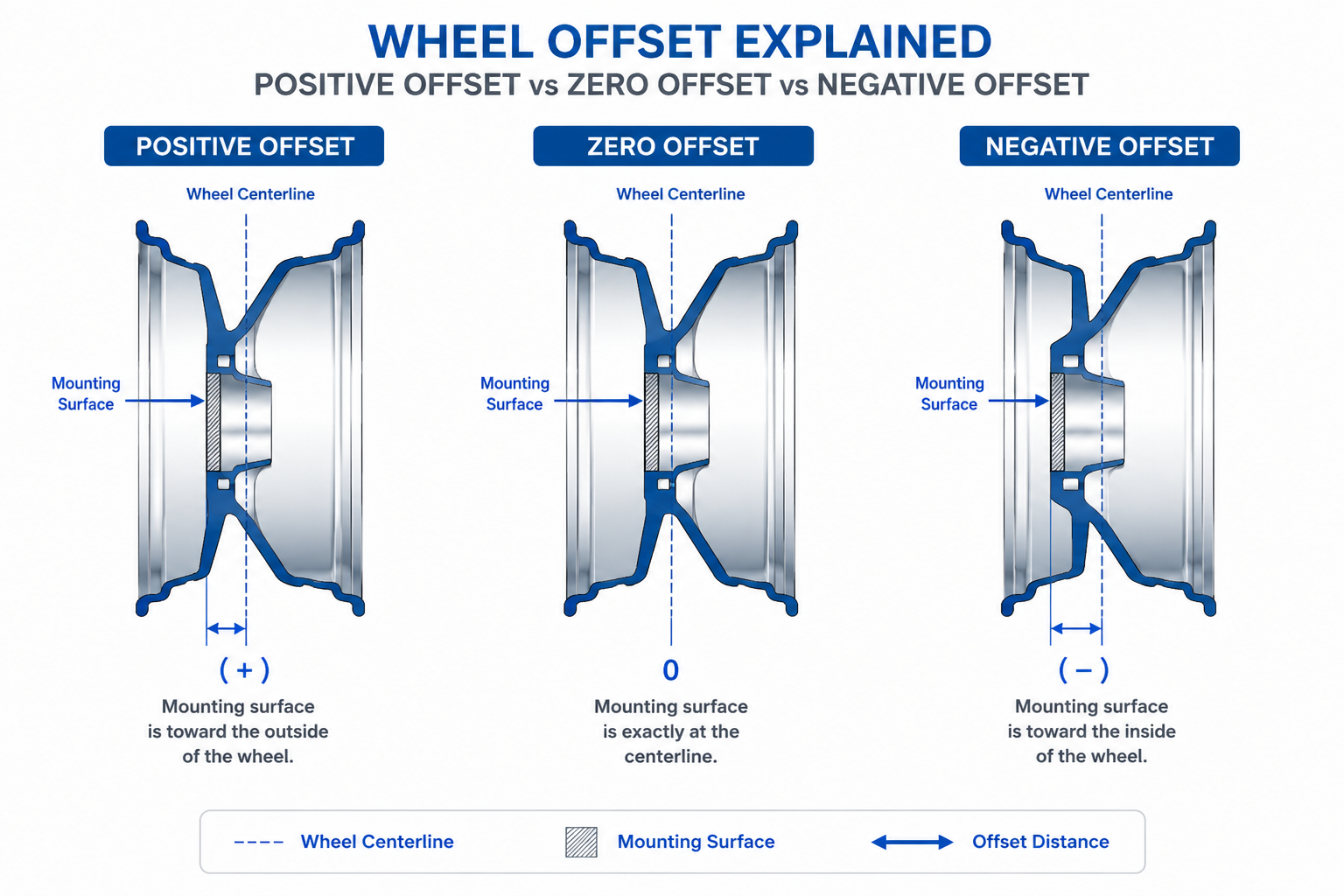
Wheel offset is the distance between the wheel's mounting surface and its centerline.
This measurement determines whether the wheel sits further inside the wheel well, perfectly centered, or further outward toward the fender.
Offset is measured in millimeters (mm) and is commonly marked with the letters ET, derived from the German word Einpresstiefe.
For example:
· ET45
· ET35
· ET20
The number following "ET" indicates how many millimeters the mounting surface is positioned away from the wheel's centerline.
Although the measurement seems simple, even a 10 mm difference can noticeably change the appearance and fitment of a vehicle.
Understanding the Wheel Centerline
To understand offset, you first need to understand the wheel centerline.
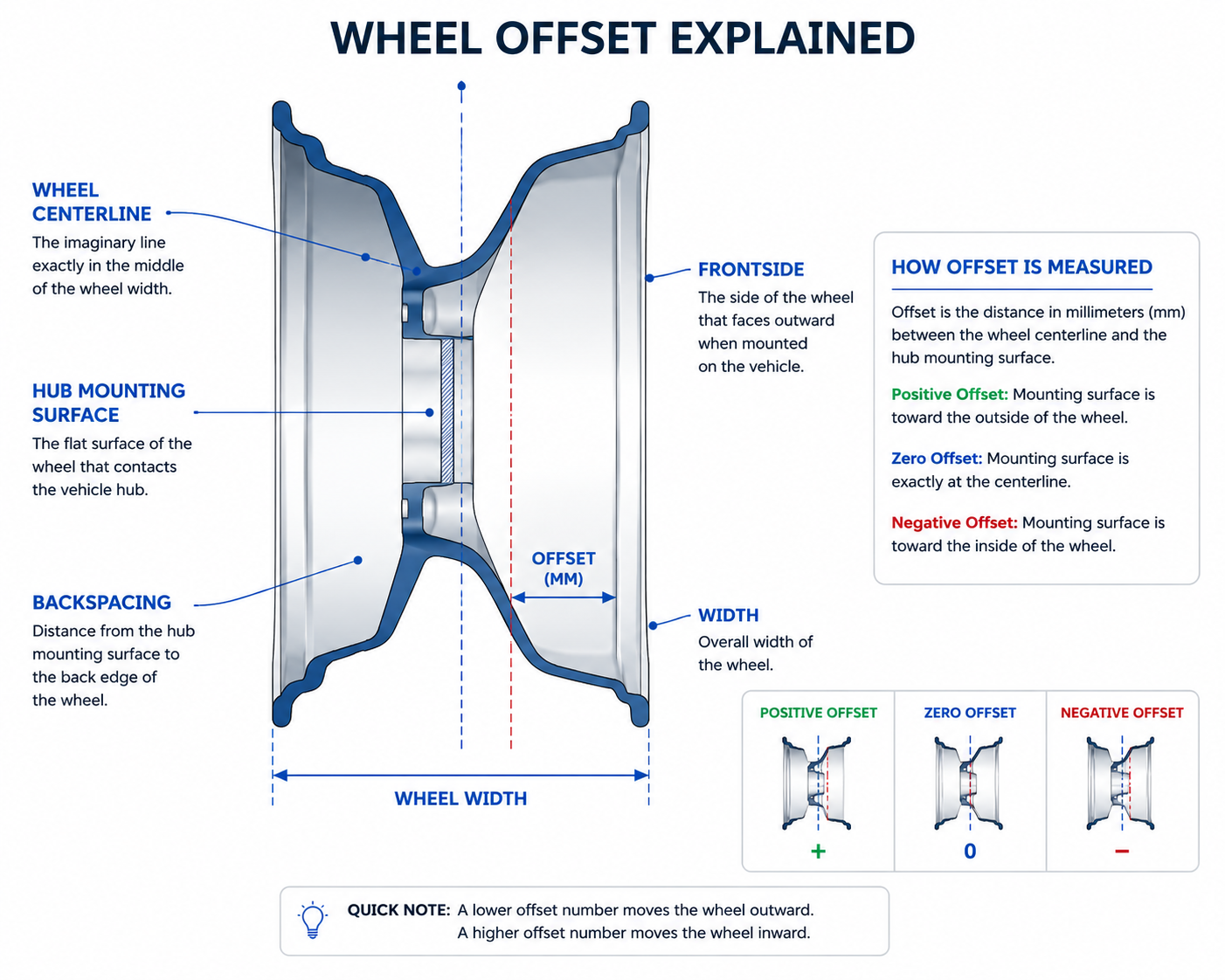
Imagine cutting a wheel exactly in half across its width. The midpoint is called the centerline.
Offset is simply the distance between:
· The centerline of the wheel
· The mounting pad where the wheel bolts to the hub
If the mounting pad moves toward the outside face of the wheel, the wheel has positive offset.
If the mounting pad sits exactly on the centerline, it has zero offset.
If the mounting pad moves toward the back of the wheel, it has negative offset.
Positive Wheel Offset
Positive offset is the most common configuration on modern passenger cars, SUVs, and electric vehicles.
With a positive offset, the mounting surface is positioned closer to the outside face of the wheel. This moves the wheel further inward toward the suspension.
Advantages of Positive Offset
· Better alignment with modern suspension geometry
· More protection for the wheel from road debris
· Suitable for front-wheel-drive and many all-wheel-drive vehicles
· Common on factory (OEM) wheel designs
Considerations
Excessively high positive offset may:
· Reduce inner suspension clearance
· Increase the chance of rubbing against suspension components
· Limit compatibility with large aftermarket brake kits
Zero Offset
A zero-offset wheel has its mounting surface positioned exactly at the wheel's centerline.
This configuration places equal portions of the wheel inside and outside the hub.
Zero offset is less common on modern passenger vehicles but is still found on certain off-road vehicles and classic applications.
Benefits
· Balanced wheel positioning
· Symmetrical appearance
· Suitable for some custom builds
Negative Wheel Offset
Negative offset places the mounting surface behind the wheel's centerline.
This pushes the wheel outward, creating a wider stance.
Negative offsets are commonly used on:
· Lifted trucks
· Off-road vehicles
· Wide-body builds
· Show cars
Advantages
· Aggressive appearance
· Wider track width
· More clearance for some suspension designs
Potential Drawbacks
Using excessive negative offset can:
· Increase stress on wheel bearings
· Cause tire rubbing on fenders
· Throw more debris onto the vehicle body
· Affect steering feel
Choosing the right balance between appearance and engineering is essential.
Why Wheel Offset Matters
Many enthusiasts focus on wheel diameter or spoke design, but offset has an even greater influence on how the wheel fits the vehicle.
The correct offset affects:
· Suspension clearance
· Fender clearance
· Steering geometry
· Brake caliper clearance
· Vehicle stability
· Tire wear
· Overall appearance
Even when two wheels share the same diameter and width, different offsets can produce dramatically different fitment results.
How Wheel Offset Changes Wheel Position
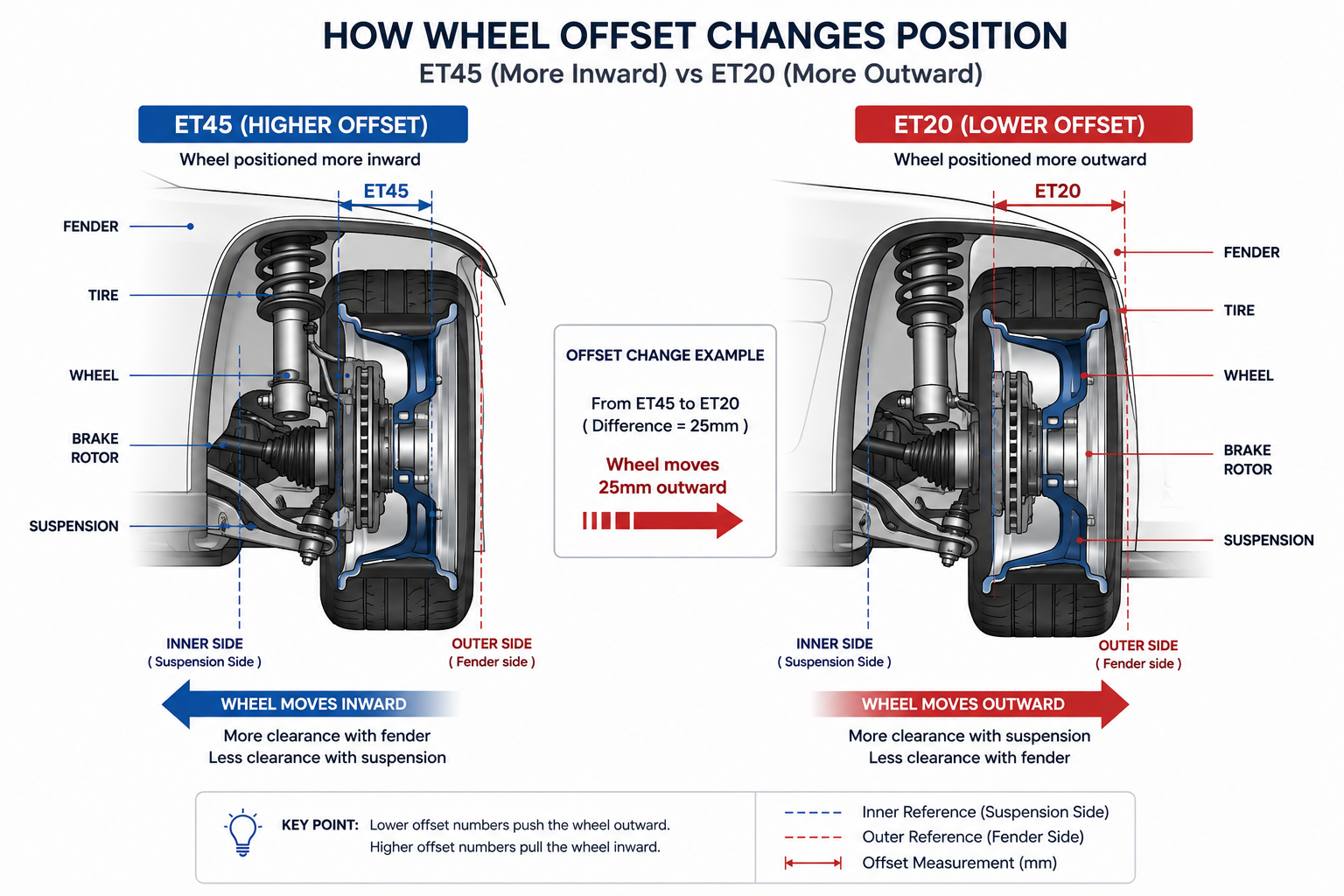
Changing wheel offset moves the entire wheel assembly inward or outward relative to the vehicle hub.
Although a difference of just 5–10 mm may seem small, it can significantly affect both appearance and performance.
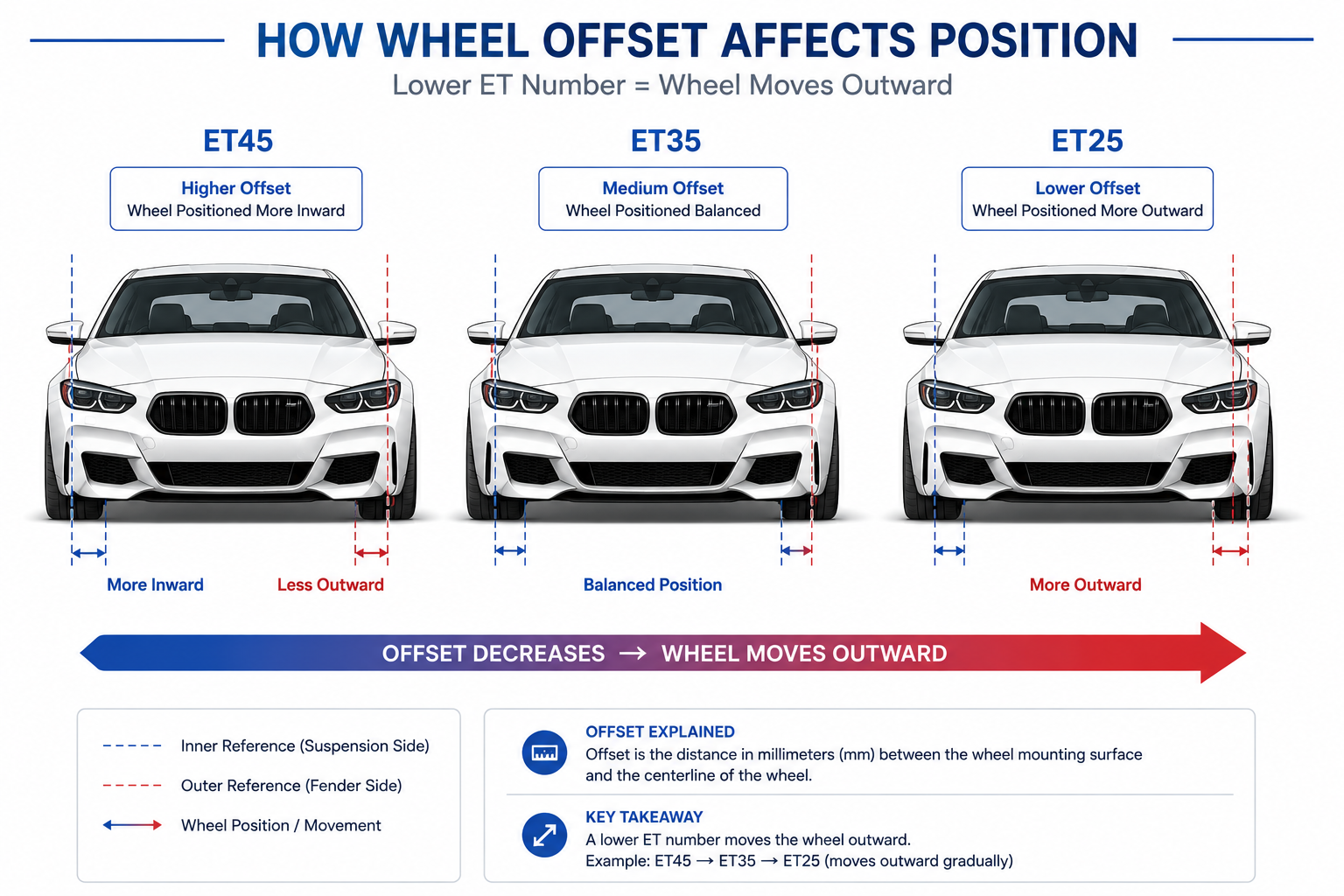
A lower offset number (for example, ET35 instead of ET45) moves the wheel farther outward. A higher offset number pulls the wheel farther inward toward the suspension.
For every millimeter the offset changes, the wheel shifts by approximately the same amount.
For example:
Original Wheel | New Wheel | Result |
20×9 ET45 | 20×9 ET35 | Wheel moves 10 mm outward |
20×9 ET45 | 20×9 ET50 | Wheel moves 5 mm inward |
20×10 ET35 | 20×10 ET25 | Wheel moves 10 mm outward |
This simple relationship makes offset one of the most influential measurements in wheel fitment.
Wheel Width and Offset Work Together
One of the most common mistakes is looking only at offset.
Offset cannot be evaluated by itself because wheel width also changes where the inner and outer lips of the wheel sit.
For example:
Original wheel:
· 19×8.5 ET45
New wheel:
· 20×10 ET35
Although the offset changes by only 10 mm, the wider wheel also extends farther inward and outward.
This combination affects:
· Fender clearance
· Suspension clearance
· Tire fitment
· Brake clearance
Whenever you change wheel width, always evaluate offset at the same time.
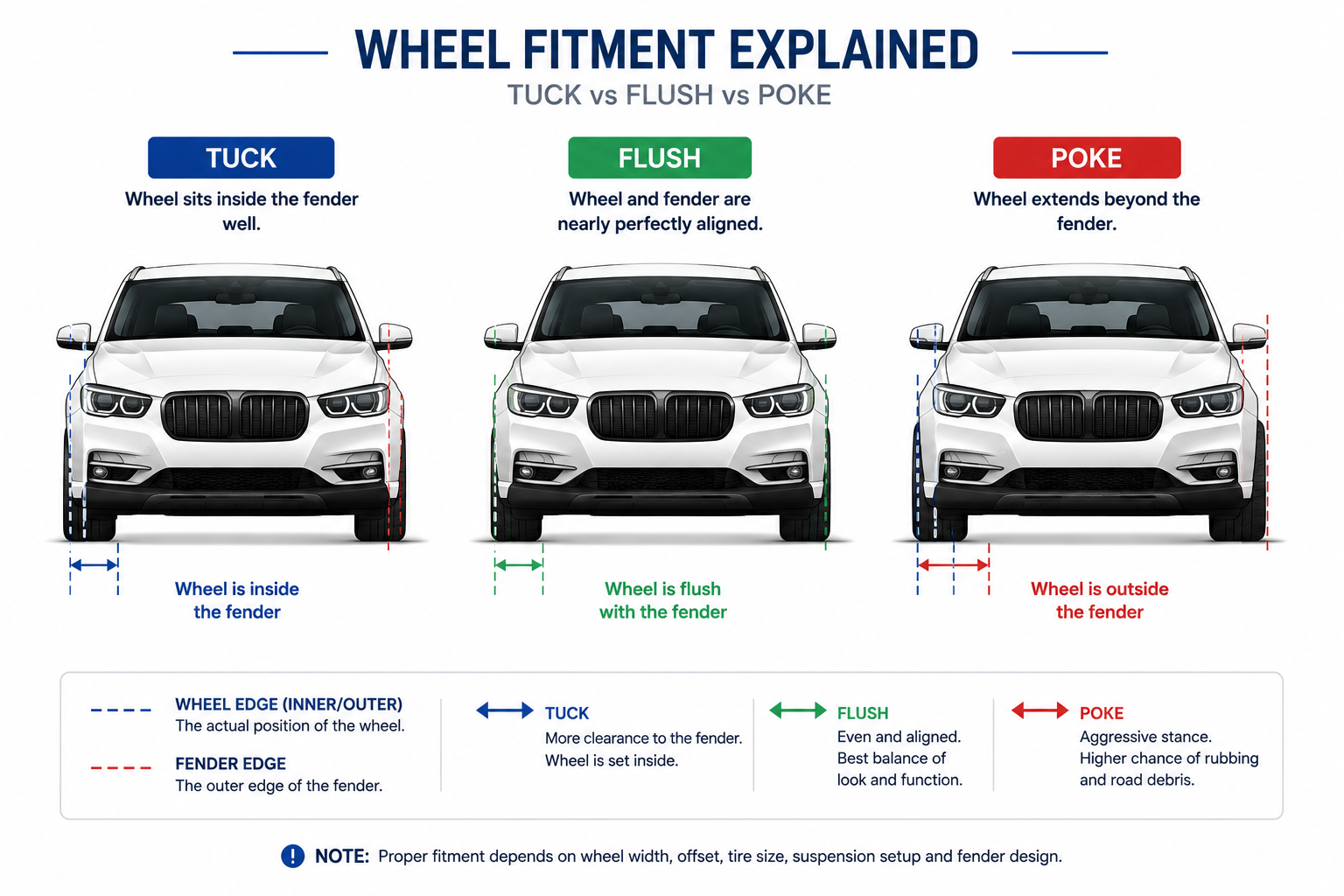
Flush, Poke and Tuck Explained
Enthusiasts often describe wheel fitment using three terms:
Flush Fitment
A flush setup places the outer edge of the wheel nearly level with the fender.
Advantages include:
· Sporty appearance
· Better stance
· Factory-like proportions
· Popular for performance street vehicles
Many aftermarket wheel manufacturers aim for a flush fitment because it balances aesthetics and functionality.
Poke
"Poke" means the wheel extends beyond the fender.
This look is common on:
· Show cars
· Wide-body builds
· Some off-road vehicles
However, excessive poke can:
· Increase dirt and stone spray
· Create rubbing during suspension travel
· Violate vehicle regulations in some countries
Tuck
"Tuck" means the wheel sits noticeably inside the fender.
This often occurs when:
· Offset is too high
· Wheel width is too narrow
Although tuck usually avoids rubbing, it may leave the vehicle looking less balanced.
Wheel Offset and Suspension Clearance
Offset directly affects the space between the wheel and suspension components.
If the offset is too high, the wheel moves inward.
Possible issues include:
· Contact with the strut
· Coilover interference
· Inner tire rubbing
· Reduced steering clearance
If the offset is too low, the wheel moves outward.
Possible issues include:
· Fender rubbing
· Increased steering scrub radius
· Greater load on wheel bearings
Proper wheel fitment always requires balancing inner and outer clearances.
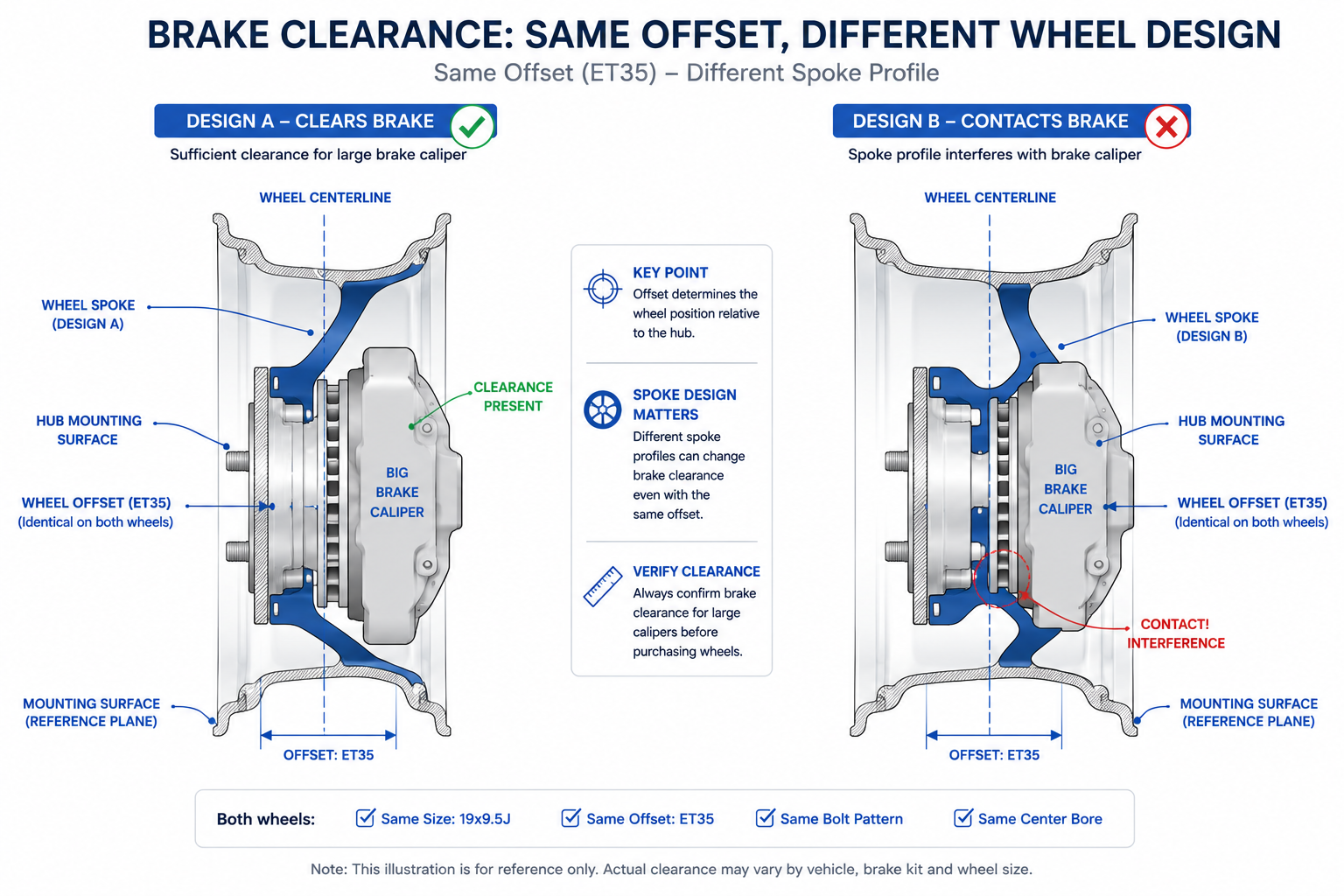
Does Wheel Offset Affect Brake Clearance?
Yes—but not always in the way many people assume.
Offset changes the wheel's position relative to the hub, but brake caliper clearance depends primarily on the wheel's spoke design and barrel profile.
Two wheels with the same:
· Diameter
· Width
· Offset
can have completely different brake clearance because of different spoke geometry.
For vehicles equipped with:
· Big Brake Kits (BBKs)
· Performance brake calipers
· Large EV brake systems
always verify brake clearance using the wheel manufacturer's specifications or templates.
Wheel Offset vs Wheel Spacers
Many people think changing offset and installing wheel spacers achieve the same result.
They are related, but they are not identical.
A wheel spacer moves the wheel outward by adding material between the hub and the wheel.
Changing to a lower-offset wheel achieves a similar outward position without adding an extra component.
For example:
Original wheel:
· ET45
Installing a 10 mm spacer results in an effective position similar to:
· ET35
However, spacers should only be used when they are designed for your vehicle and installed according to the manufacturer's instructions.
How Offset Influences Vehicle Handling
Offset affects more than appearance.
It also influences steering and suspension geometry.
A significant change in offset can affect:
· Steering feel
· Straight-line stability
· Scrub radius
· Cornering response
· Wheel bearing load
Small changes that stay within the manufacturer's recommended fitment range are generally easier to accommodate than extreme modifications.
Wheel Offset on Electric Vehicles
Electric vehicles place unique demands on wheel fitment.
Compared with many gasoline-powered cars, EVs often have:
· Higher vehicle weight
· Greater instant torque
· Larger brake systems
· Higher wheel load requirements
Correct offset helps maintain:
· Brake clearance
· Suspension clearance
· Tire wear characteristics
· Predictable handling
When selecting aftermarket wheels for EVs, offset should always be considered alongside load rating and wheel construction.
How to Choose the Right Wheel Offset
The best wheel offset depends on your vehicle, wheel width, tire size, suspension setup, and intended use. There isn't a single offset that works for every application.
Before ordering aftermarket wheels, verify the following specifications:
· Vehicle bolt pattern (PCD)
· Center bore
· Wheel diameter
· Wheel width
· Tire size
· Brake caliper dimensions
· Suspension modifications
· Fender clearance
Choosing the correct offset means balancing appearance with safe and reliable fitment.
Typical Offset Ranges by Vehicle Type
The values below are examples only. Always confirm the specifications for your exact vehicle.
Vehicle Type | Typical Offset Range* |
Compact cars | ET35–ET50 |
Sports sedans | ET25–ET45 |
SUVs | ET30–ET50 |
Electric vehicles | ET35–ET50 |
Pickup trucks | ET0–ET30 |
*Actual specifications vary by manufacturer, model year, wheel width, and brake package.
Example: Understanding ET45 vs ET35
Suppose your original wheel is:
19×8.5 ET45
You upgrade to:
19×8.5 ET35
The wheel moves approximately 10 mm outward.
Possible benefits include:
· A more flush appearance
· Slightly wider track width
However, before making the change, check:
· Fender clearance during suspension compression
· Tire clearance at full steering lock
· Brake caliper clearance
· Local regulations regarding tire coverage
Even relatively small offset changes should be evaluated as part of the complete wheel and tire package.
Common Wheel Offset Mistakes
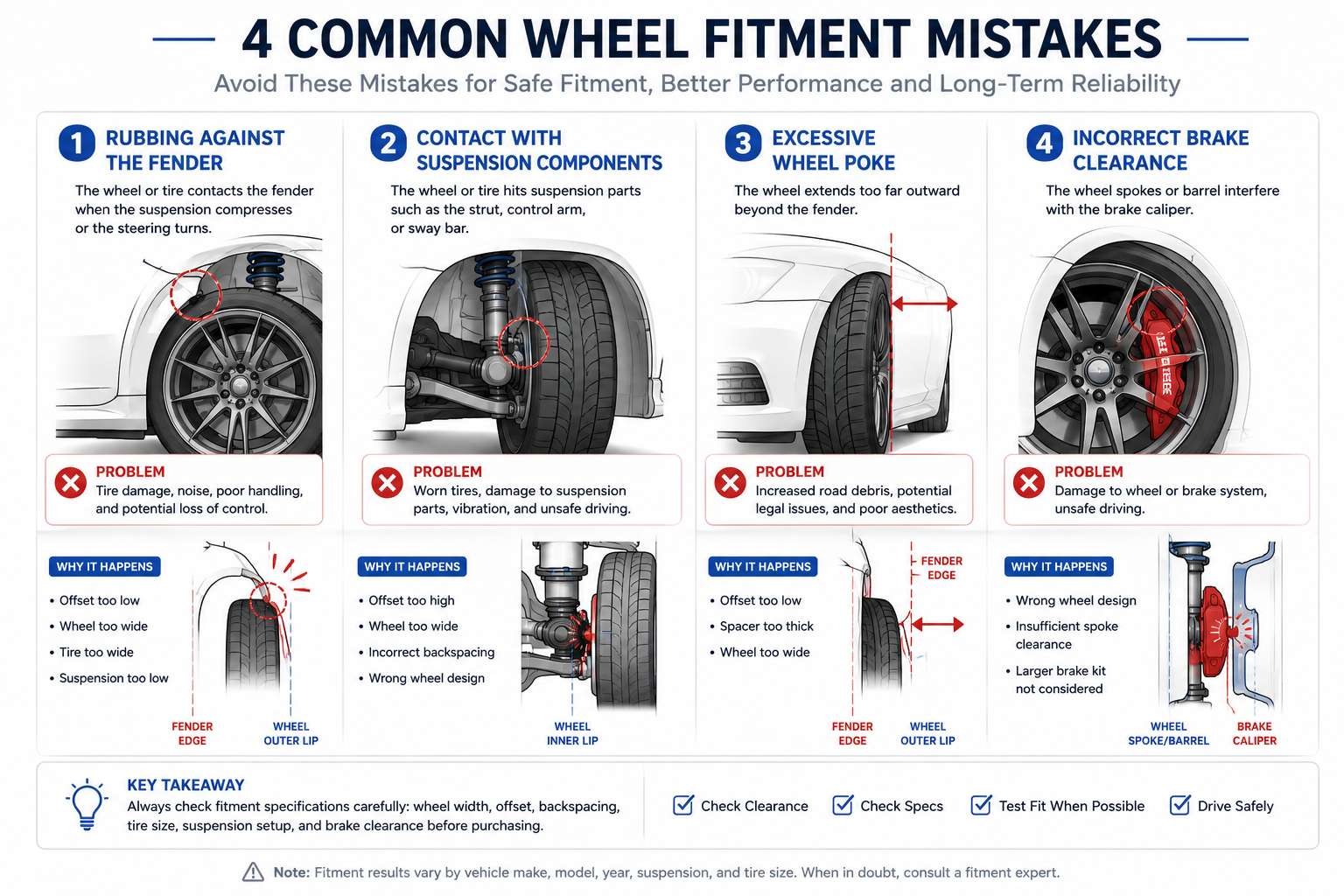
Avoid these common errors when purchasing aftermarket wheels.
Choosing Wheels Based Only on Appearance
A wheel may look perfect online but still have the wrong offset for your vehicle.
Ignoring Wheel Width
Offset and wheel width always work together.
A wider wheel with the same offset occupies more space both inside and outside the wheel well.
Forgetting Suspension Modifications
Lowering springs and coilovers reduce available clearance.
An offset that works on a stock vehicle may not fit after the suspension is lowered.
Assuming Offset Determines Brake Clearance
Offset is only one factor.
Spoke shape, barrel design, and wheel profile also determine whether a wheel clears large brake calipers.
Buying Without Confirming Vehicle Specifications
Never assume that all model years share the same fitment.
Manufacturers may change offsets, brake packages, or suspension geometry during a model's production cycle.
Wheel Offset and TISLI Flow Formed Wheels
At TISLI Wheels, offset is considered during the engineering stage—not as an afterthought.
Our flow formed wheel programs are developed with attention to:
· Vehicle-specific fitment
· Brake caliper compatibility
· Appropriate load ratings
· Suspension clearance
· Modern EV applications
· Performance street and OEM requirements
By combining lightweight flow formed construction with carefully engineered fitment specifications, we aim to provide wheels that deliver both performance and confidence.
Frequently Asked Questions
What does ET mean on a wheel?
ET is the abbreviation commonly used for wheel offset. It indicates the distance, in millimeters, between the wheel's mounting surface and its centerline.
Is a lower offset always better?
No.
A lower offset moves the wheel outward, but too little offset can increase the risk of fender rubbing, additional wheel bearing load, or changes in steering characteristics.
Can changing wheel offset improve handling?
A moderate change may influence handling characteristics, but wheel width, tire selection, suspension setup, and alignment also play important roles.
Can I use wheel spacers instead of changing offset?
In some applications, spacers can move the wheel outward. However, they should be chosen carefully and installed according to the manufacturer's recommendations. Selecting wheels with the correct offset from the start is often the simpler solution.
Does wheel offset affect tire wear?
Incorrect offset can contribute to uneven loading on suspension and steering components. Tire wear is also affected by alignment, tire pressure, and driving conditions.
Does wheel offset affect EV range?
Offset itself has only a limited effect. However, changes in wheel width, tire size, wheel weight, and aerodynamic design may influence overall efficiency.
Key Takeaways
Before purchasing aftermarket wheels, remember these principles:
· Wheel offset determines how far the wheel sits inward or outward.
· Offset must be evaluated together with wheel width.
· Brake clearance depends on both offset and wheel design.
· A flush fitment should never compromise safety or suspension clearance.
· Always verify all wheel specifications before ordering.
Understanding offset helps you choose wheels that not only enhance the appearance of your vehicle but also maintain proper fitment, handling, and long-term reliability.
Recommended Reading
Continue learning with these guides:
· How to Read Wheel Specifications – Complete Guide
· Wheel Bolt Pattern Explained – What Is PCD?
· Wheel Center Bore Explained
· How to Choose the Right Wheel Width
· Hub-Centric vs Lug-Centric Wheels
· Wheel Load Rating Explained
· Flow Formed Wheels vs Cast Wheels
· How to Choose Wheels for Big Brake Kits
These articles create a complete knowledge hub that helps readers understand every aspect of aftermarket wheel selection.
Suggested External References
When appropriate, reference recognized industry standards and organizations to reinforce technical accuracy, such as:
· SAE International
· ISO wheel-related standards
· JWL certification information
· VIA verification program
Avoid excessive outbound links—only link where they genuinely add value for readers.